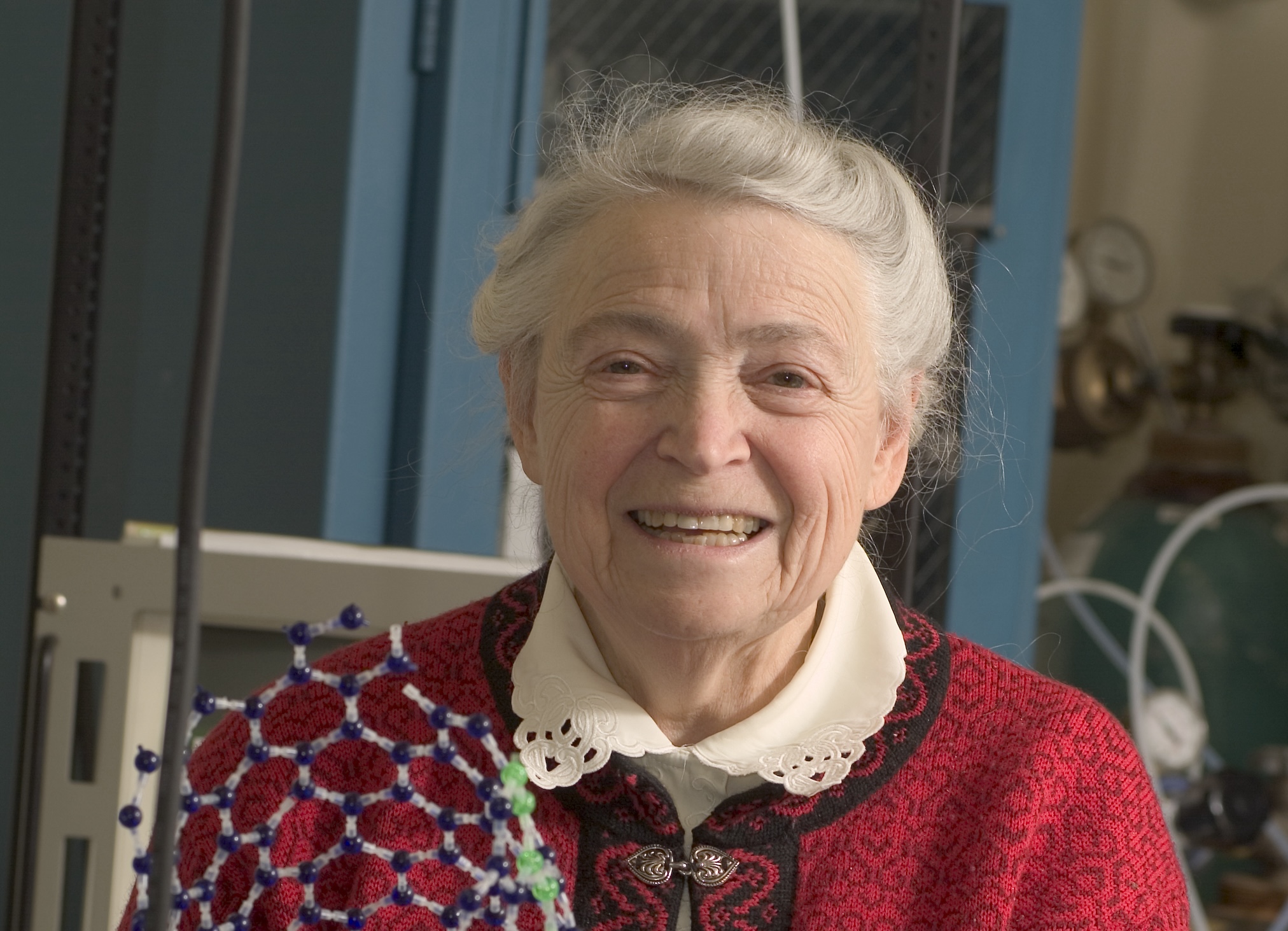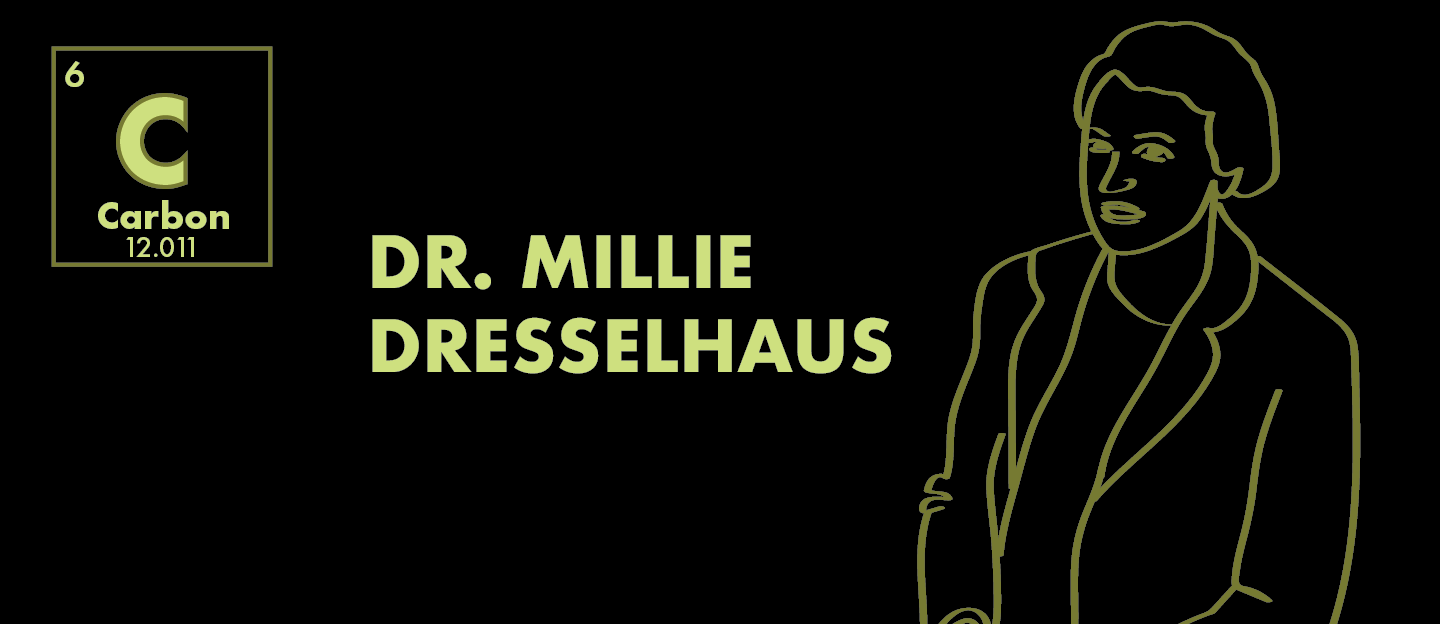
Born in 1930, Professor Mildred Dresselhaus grew up in some of the roughest neighborhoods New York City. She attended New York City public schools through junior high school, at which time she wrote that her dream job was “secretary” (and later, “schoolteacher”). She never even imagined she could become a scientist.
She was accepted into Hunter College High School, then Hunter College, where Nobel prize winner Rosalyn Yalow encouraged her to pursue a career in science. Professor Dresselhaus went on to receive a PhD from the University of Chicago, followed by a postdoc at Cornell, where she researched superconductivity.
When she began her independent career in 1960 as a member of the research staff at the MIT Lincoln Laboratory, she was informed she could no longer study superconductivity, as it was a “dead field”. She decided to study carbon, and carried out a series of experiments that led to a fundamental understanding of the electronic structure of semi-metals, especially graphite. This led to her appointment as an MIT faculty member in 1967 and as an Institute Professor in the departments of Physics and Electrical Engineering in 1985. She served as the Director of the Office of Science at the U.S. Department of Energy in 2000-01, and was an officer in many national organizations in physics, engineering, and related areas. Honors and awards included 37 honorary doctorates worldwide, and the National Medal of Science, the Nicholson Medal for Humanitarian Service, the Compton Award, the Fermi Prize, the Kavli Prize, and the U.S. Presidential Medal of Freedom, as well as the IEEE Founders Medal and the IEEE Medal of Honor
Professor Dresselhaus’s research over the years covered a wide range of topics in condensed matter and materials physics. She was best known for her work on carbon science and carbon nanostructures, as well as nanoscience and nanotechnology more generally. She was also one of the researchers responsible for the resurgence of the thermoelectrics research field through her early work on low-dimensional thermoelectricity in the early 1990s. She co-chaired a Department of Energy study on “Basic Research Needs for the Hydrogen Economy” in 2003 and co-chaired the National Academy Decadal Study of Condensed Matter and Materials Physics in 2007. She co-authored more than 1700 publications including books, book chapters, invited review articles, and peer-reviewed journal articles. In addition, Professor Dresselhaus continually advocated for and supported activities to promote the increased participation of women in science and engineering.
Even in her final years, Professor Dresselhaus continued to research and mentor students seven days a week. She always relished the chance to get up in the morning and go into the lab. She felt she had the best career in the world, and she never wanted to stop. Professor Dresselhaus passed away in February of 2017. She is survived by her husband, her four children and five grandchildren, the fields of research she helped pioneer and revive, and a worldwide collection of students, colleagues, and scientists who extend her legacy through their passion for science.